Canada's Next Chapter in Trans-Continental Rail
Canada finally bought a new continental train, what does it look like and will it last as long as our iconic Budd Rail cars?
Before heading south for autumn I read some exceptional news, even more magnificent than the elusive high speed Alto news, which is that the federal government and their crown corporation finished a procurement process and actually bought a new trans-continental fleet, the first in over 70 years. VIA Rail has ordered new cars for the national long distance rail network, and even new locomotives to pull them! By the time I’m in my thirties, I’ll be crossing this country in the first genuinely modern Canadian trans-continental train since the 1950s, which is something I’ve wanted to write for most of my adult life.
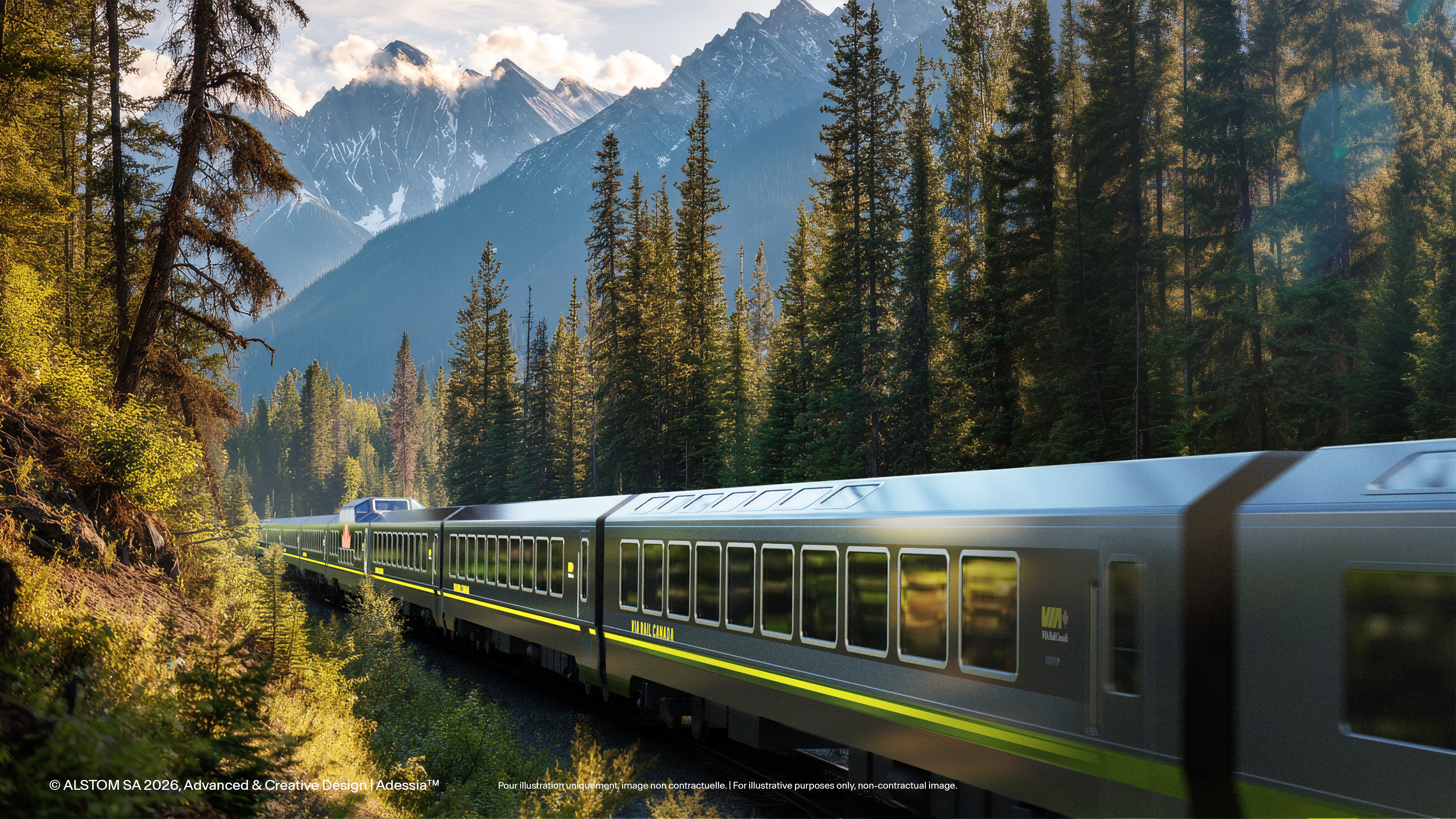
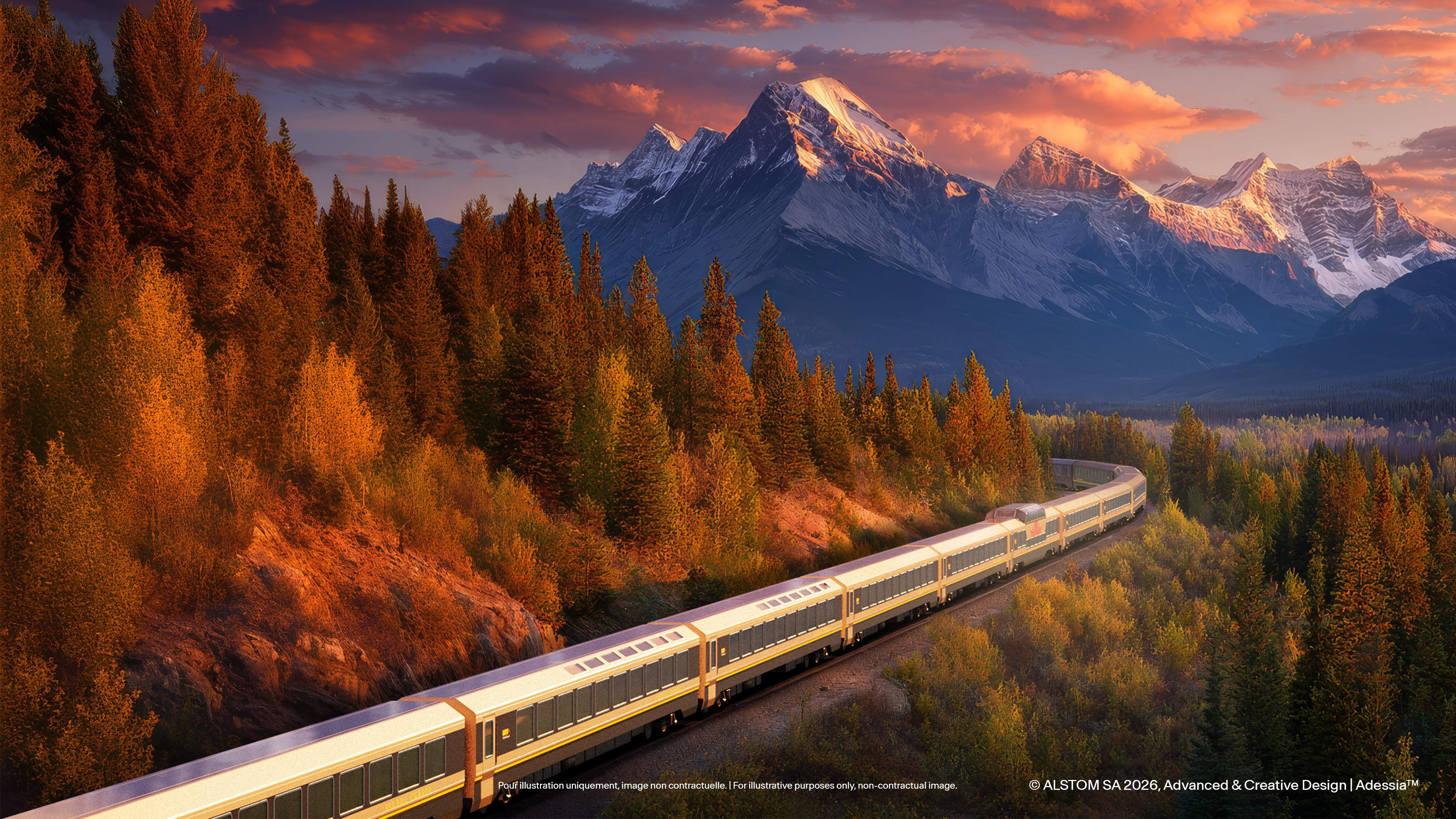
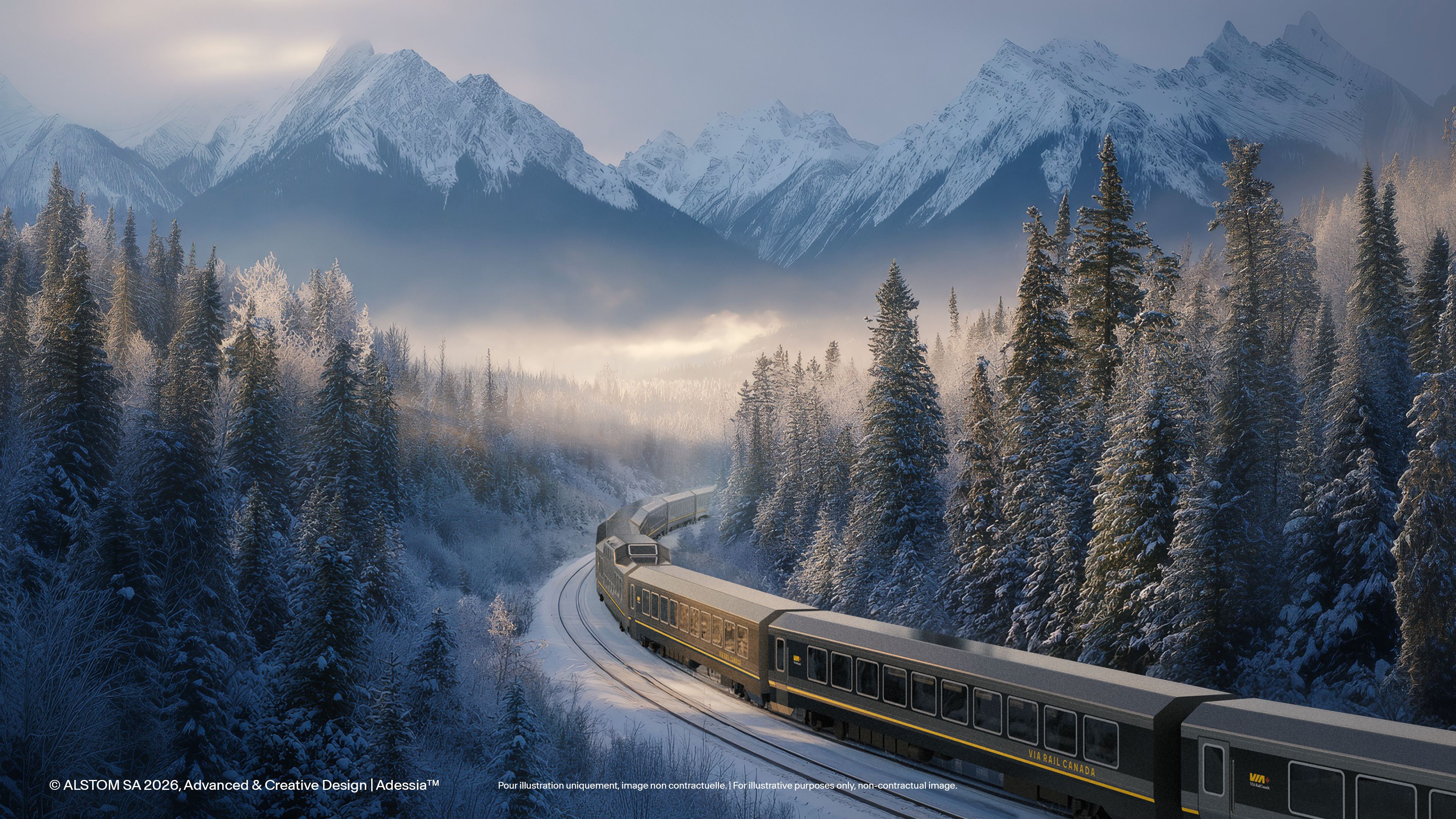
All images in this article are renderings from Alstom’s press kit. Copyright Alstom SA 2026, Advanced & Creative Design.
On my last train trip across the country, my fourth on The Canadian, I heard rumours about new cars and immediately started thinking of the journey like a goodbye. Every dome I sat in, every vestibule I stood in at 2 in the morning, I was memorizing the feeling and feeling a bit of anticipatory grief. Fortunately there were other train nerds aboard, as there always are, and they slapped some sense into me by resetting my expectations for at least 2 more years of Budd cars. That was 2025, and here we are in 2026 with newly tempered timelines after this news!
So before anything else, the timeline, because I spent years worrying about it and I wouldn’t want anyone else to repeat my railroad lover’s angst. First deliveries land in 2031, with trains being brought into service gradually until 2035. The new equipment phases in alongside the legacy fleet rather than replacing it over a long weekend, which will make for excellent rail fan photography, I’m sure. If you’ve been putting off riding a stainless steel Budd train across Canada, you have somewhere between 5 and 9 years to get around to it, which is more runway than most of us get on anything we love. Most of the folks who see my blog or read my podcast posters immediately drum up how they’ve wanted to cross the country by train, and to them, I always say to just get out there and do it.
Manifest
Here’s what the feds bought, in a nice summary table so that I don’t have to keep reciting numbers and you don’t have to untangle it all through sentences, satire, and heart ache. Why don’t news articles do this I wonder?
| Car type | Count |
|---|---|
| Sleeper | 78 |
| Coach | 58 |
| Panorama | 38 |
| Baggage | 29 |
| Accessible sleeper | 26 |
| Dome | 25 |
| Dining | 20 |
| Prestige sleeper | 20 |
| Berth | 19 |
| Total | 313 |
| The package | Detail |
|---|---|
| Cars | 313 Alstom cars, roughly $4 billion |
| Car support | 15-year Technical Support and Spare Parts Supply Agreement, nearly $700 million, expires 2041 |
| Locomotives | 45 Stadler hybrid battery-diesel units, $1.6 billion, 20-year support to 2046 |
| Maintenance facility | $357 million VIA facility in Montréal, built by Pomerleau, completing 2029 |
| Combined federal commitment | Above $6.6 billion |
| Canadian work | Design at Saint-Bruno-de-Montarville, carbodies at La Pocatière, final assembly at Thunder Bay, up to 36 locomotives assembled domestically |
| In service | Locomotives from 2029, first cars 2031, full deployment 2035 |
Counting the Cars
If you want to know what a transportation agency actually believes, don’t read the press release, count the rail cars.
143 of those 313 cars carry sleeping accommodation, which is 46 per cent of the order. There are 63 sightseeing cars once you add the domes and the panoramas together, against 58 coaches, which means the experience is just as important as it always has been. There are 20 dining cars with full stainless kitchens and 29 baggage cars, which means full-service dining and checked baggage both survived procurement instead of getting value-engineered into a hallway food trolley like in Harry Potter and a carry-on policy like on Air Canada.
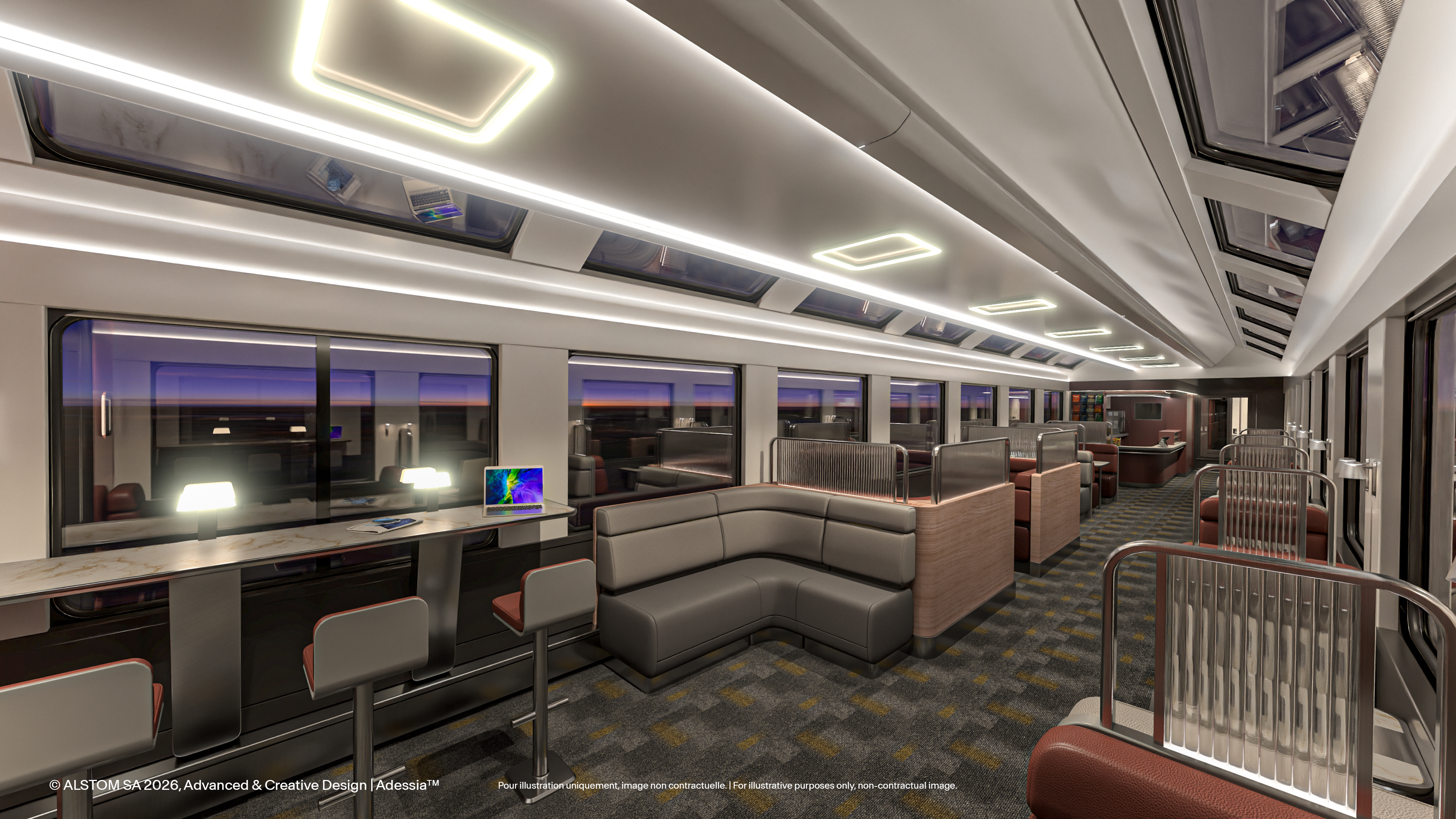
The panorama lounge, with bench segments walled off in wood and glass for conversation, and a counter that assumes you brought a laptop.
This is a fleet procured as a rolling house. Rather than looking per seat, we have to consider that every passenger needs a bed, a shower, a dining seat, and a dome seat, because the trip is 4,466 km and 4 nights long. You could operate The Canadian more cheaply, and you could even do what France, the USA, or Australia does: Charge more for less accommodations and a shorter trip. Someone at some point in the last 40 years surely proposed it, and I think all rail fans and true Canadians are grateful that nobody listened to them.
The renderings from Alstom fill in the rest of our details today, with the usual caveat that renderings are marketing, so naturally I’ll believe the details when I’m sitting in them. We’ve got skylights in the sleepers and cabins, now, which should reduce the feeling of sleeping below deck on a ship. Dome cars will be keeping their familiar two-level arrangement, though I’m confused about how the accessibility will work on the lower level (keep reading to get what I mean). Dining cars are trading the individually awkward metal chairs for 1950’s diner benches, which is a straightforward improvement, seemingly at the cost of the etched and framed decorative glass, which is being replaced by glass dividers between the tables that no longer reach the ceiling. I’ll miss the glass, the renderings make the dining cars look remarkably less artistic and unique to the train. Still, I recognize that being sad about decorative glass on a $4 billion order is minor relative to the other key characteristics that are being kept.
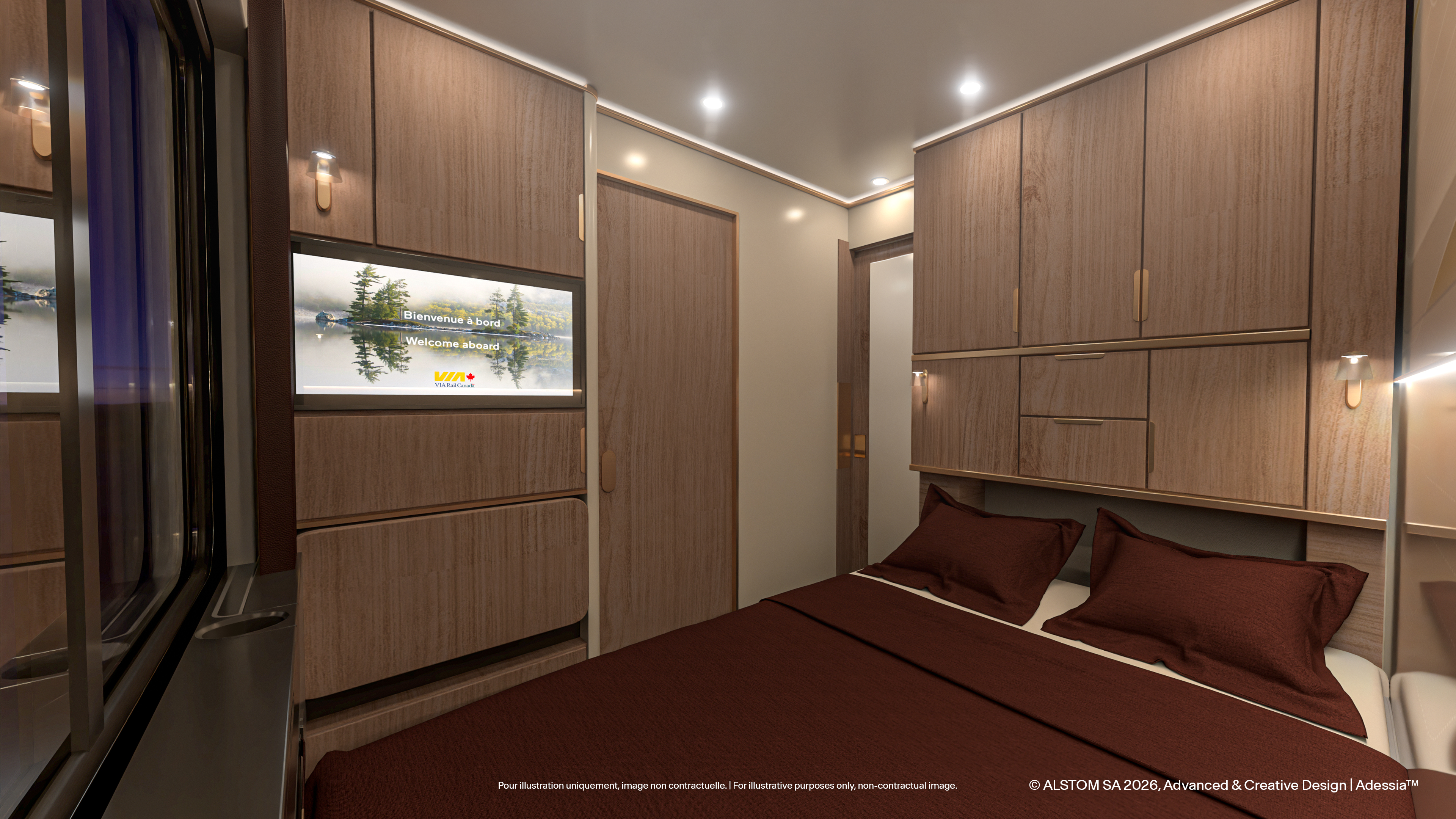
A cabin at dusk. The skylight is the detail I keep coming back to.
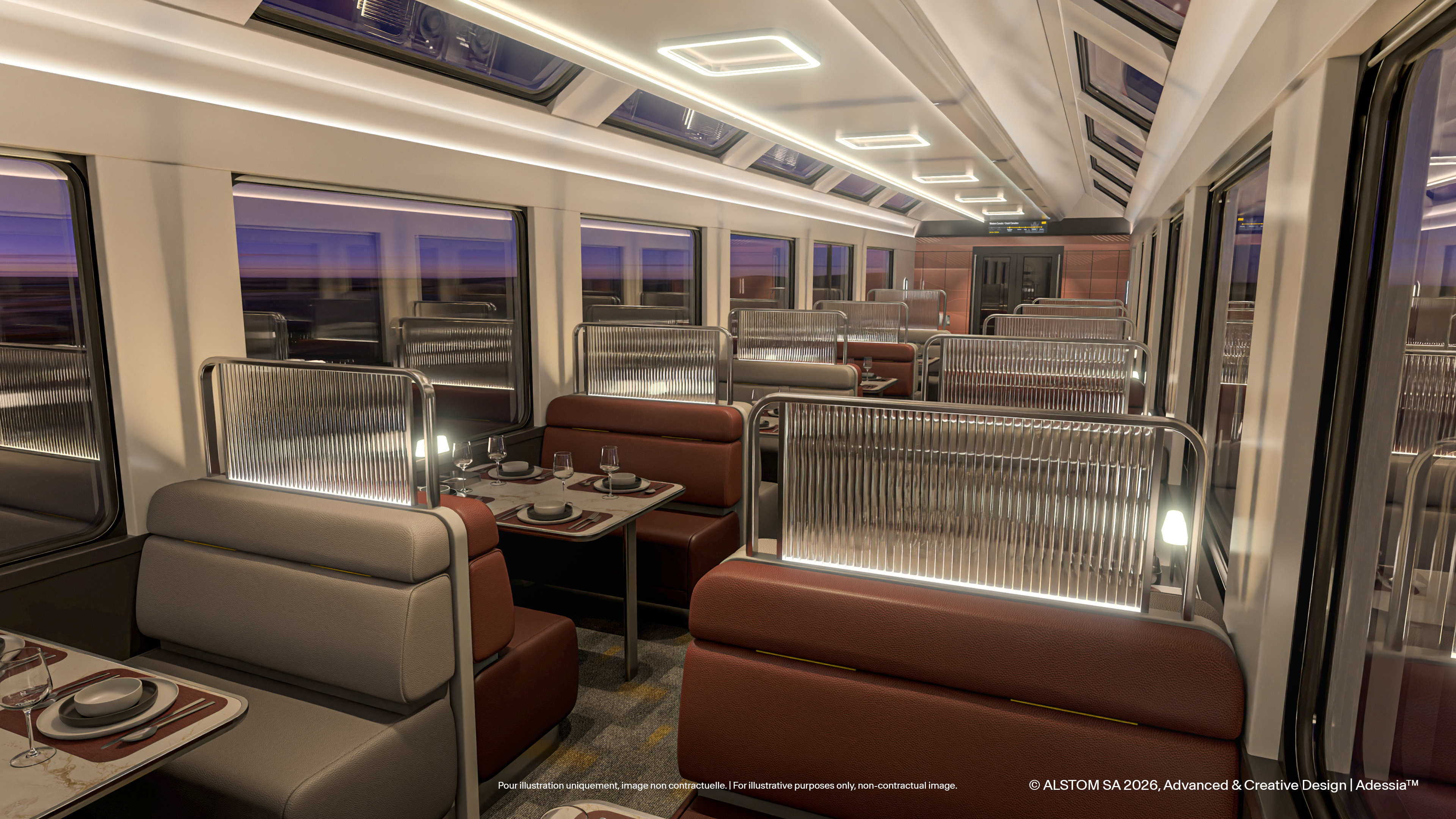
The dining car, benches in and etched glass out.
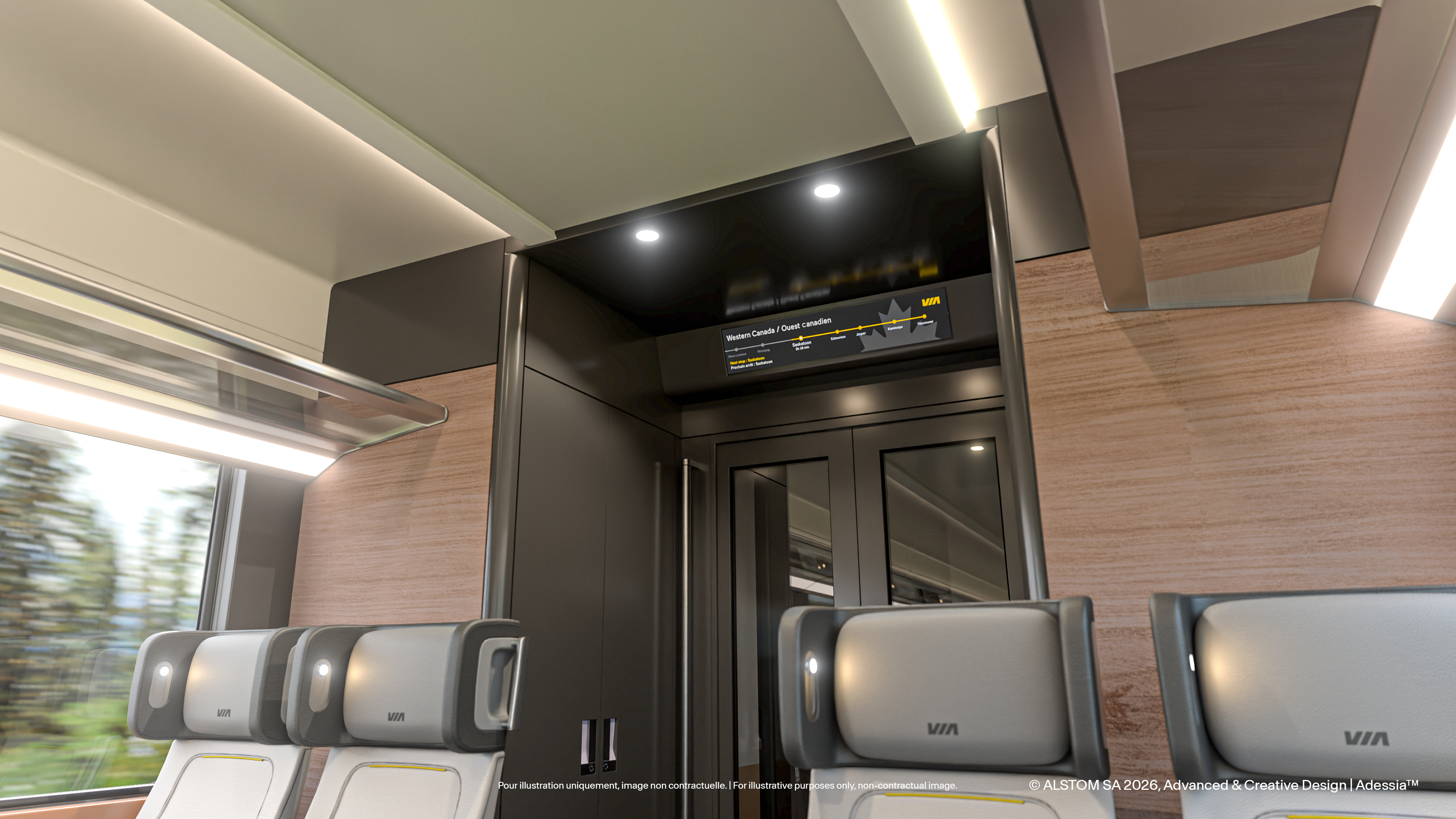
The coach car, and the only daylight interior in the press kit. Headrest reading lights, glass luggage racks in the Venture style, and digital signage everywhere.
Real Accessibility
There are 26 accessible sleepers in that table, and Transport Canada’s language around the order promises an accessible travel path connecting cabins, washrooms, dining services, and key onboard amenities, including the upper level of the dome. This is probably the biggest change inside of the rail cars, which will massively impact the future of ridership.
The existing fleet has been described as “accessible” for years, on the basis of one accessible cabin in each of 4 Park cars, at the tail end of the train, available only in the top fare class. That treats the cabin as the unit of accessibility, when the unit is actually the journey. Not to mention, I have no idea how anyone with a mobility disability could possibly enter a cabin on their own, let alone go through the hallways. I mean, picture this: Bed to washroom, bed to dining table, dining table to sightseeing dome, 4 or 5 times a day, through vestibules across multiple rail cars, and 63 cm wide doors, in a wheelchair or walker or walking sticks, on a train going 100km/h. Yeah right, good luck with even getting aboard, let alone down the hallway to your cabin.
Hey wait a minute, this guy can walk, why does he care? My first trip on The Canadian and The Ocean was Vancouver to Halifax in 2019, with my ex-wife, who was primarily wheelchair bound at the time and who, thanks to some remarkable surgeries, could manage short distances with carbon fiber walking sticks and careful assistance. We were most of a train away from the dining car, maybe 8 or more rail cars. After 2 days of watching us make that trip several times daily, the service manager for the train decided that was enough and moved us to a cabin adjacent to the dining car. That Québecois man’s decision changed the entire character of the journey for us, and I’ve thought about him often since.
I also knew, even then, that we’d been very lucky. We got a sympathetic manager, an available cabin, and a passenger who could walk a little with help from a partner who was there to give it. Someone fully wheelchair bound with none of those three things simply can’t take that train, and the reason isn’t the cabin vs sleeper class, it’s the 15 vestibules between the cabin and dinner. The train was class-based from the ticket right down to the metal, and I’m not even considering vestibules in winter which can be extremely slippery with a layer of snow.
So when the government says accessible travel path, they’re describing, in their own words, the exact thing that was missing. No door widths, no gangway dimensions, no boarding mechanism, no word on whether the path is safe when the train is doing 100 km/h through the Skeena valley rather than sitting flat at a platform in Winnipeg. My experience is my reason for asking these questions on accessibility and why I won’t simply accept the vendor’s renderings.
Looking at those renderings, Alstom is marketing concepts of wheelchair lifts up to the second level of dome cars, dedicated tables in the dining room for wheelchair users, narrower dome seating for wide aisles, wheelchair platforms that prevent undesired movement, sleeper bunks that have dedicated storage cupboards instead of assuming all your luggage will be shoved under the lower bunk, and platform level doors and floors. That last one is the one I genuinely can’t work out. Almost every platform in this country sits so low that passengers board the current fleet by climbing a set of portable steps that a service manager sets down by hand, so platform level boarding means either rebuilding several hundred platforms across 12,500 km of railway, or carrying some kind of lift on the car itself, and the renderings show neither. The rest of the marketing materials raise their own questions, and give us some new worries. The widened aisles couldn’t come out of thin air, and the chair lift with a dedicated wheelchair spot had to eliminate something. So now upper level dome car seats appear cramped and to no longer include tables in the first row for puzzles, reading, or snacks. A minor bummer for someone as privileged and temporarily able-bodied as myself. In the long run, when I’m as old as the current fleet of rollingstock, I’ll be darn grateful that of all the privileges ripped out from under me, the train across Canada won’t be one of them.
About the money
$12.8 million per car, on average, and I’ll grant that the number sounds obscene right up until you look at what else we buy at federal scales.
Sometimes it’s best to think about these things generationally. The Budd cars cost about $2.69 million each in today’s money when they were ordered in 1955. The Siemens Venture cars in the 2018 Quebec-Ontario corridor order work out to roughly $6 million each once you erase the locomotive prices out of their full order price. These new transcontinental cars come in at $12.8 million. The price doubles each generation, and the gap between the last 2 generations is only 8 years, but COVID-19, a tariff war, and a reduction in our heavy rail rollingstock production has clearly gutted our economics. Even if you can reasonably argue that the technical standards and technologies in those Siemens Venture cars isn’t far enough away from the Alstom cars to justify twice the price, what we’re getting is worth more than twice as much. Given those Venture cars are just coach cars with very few amenities, paying twice as much for beds, showers, dining rooms, kitchens, panorama dome cars, lounges, and more seems pretty good.
Another way of looking at it is how specialized each design is for a given set of customers, or in other words their total production volume. In 1955, Budd amortized a common shell for many railroads, worldwide. Siemens is still amortizing the Venture platform across Amtrak, VIA, and Brightline. Alstom is now amortizing 9 bespoke car types across 313 cars for a single customer, which averages 35 units per type. When you’re the only buyer in the world for a Canadian long distance panorama car, you end up paying for the entire engineering program.
For what it’s worth, the aviation comparison still flatters rail badly. An A220-300 runs around $1,600 per kilogram of empty weight against roughly $210 per kilogram for a rail car of Budd-comparable mass, so rail comes in around an eighth the cost per kilo, which is about what an unpowered, unpressurized vehicle should manage… The reason airframes cost what they do isn’t complexity in the abstract, it’s pressurization cycles and fatigue life, and a train car simply never has to survive that.
There’s also a pile of content baked in now that wasn’t in 1955. Crash energy management, accessibility to the current standard as mentioned, fire and smoke standards, modern HVAC, digital passenger information and next-station signage, connectivity, and cybersecurity. Some of that exists on the current fleet, but every bit of it was paid for separately, in a series of refurbishments spread over 70 years. Now, we’re buying all of that up front of the fleet’s future, which makes it a little more reasonable.
Now, a more critical figure of the cost is likely to be based on annual ridership, which at only 216,000 annual long-distance passengers per year in Canada, puts our first year of cost/rider at $21,750 if you count the entire $4.7 billion package rather than the cars alone. You could argue that because these trains will run for decades, it really comes down to about $300 to $500 per passenger over the total lifespan, but then you need to consider the total cost of maintenance and upgrades over all those decades. However, I would say that cost per passenger for any length of time is the wrong denominator. Our long distance routes reach 93 Indigenous communities with no alternative public surface transport, and close to 400 communities in total across 12,500 km, many of them nowhere near an airport and served by no buses. Also, the ridership is supply-constrained rather than demand-constrained, because you cannot generate volume on a train that runs twice a week and sells out its sleepers months ahead.
The 77-year problem
Everyone repeats the same line about this fleet, which is that these cars have run for 70-odd years and isn’t that a testament to how well they built things way back when? It’s romantic and it’s common about everything from stone fortresses to old appliances, but it’s out of touch with the realities of our economy and it really misses the mark on how Canadians take good care of their belongings (unless we privatize them, I’m looking at you BC Rail).
Standard passenger rail design life is 35 to 40 years. VIA converted the entire stainless fleet to head-end power in the late 1980s, roughly 35 years in, meeting that design life perfectly. Canada bought a 35-year train and then chose, more than once, to rebuild it rather than replace it. Transport Canada itself has noted that about 75 per cent of the long distance fleet is over 65 years old. So the fact of the matter is, our long distance rail cars today are not, in any meaningful sense, the cars Budd delivered. Between the upgrades I mentioned earlier in the article and the refurbishment they’ve gone through over the years, they’re closer to you and I compared to ourself a decade ago: Almost the same blueprint but 99% different atoms.
Which brings me to a new idea to mull over and a new worry. Alstom names cybersecurity as a design feature, and as I happen to work in cybersecurity, I know what that sentence actually commits VIA Rail to in the future. It means networked, software-defined subsystems with an update lifecycle, and ultimately that means we’re now likely to be dependent on a vendor. The Alstom support agreement expires in 2041. Stadler’s expires in 2046. Neither vendor has committed anything past the middle of the century for equipment that will be expected to run into the 2070s, which is what the last fleet accomplished.
A stainless steel carbody has no obsolescence date. A train control and management system has one whether anybody says it out loud or not. You can machine a Budd door latch in a VIA shop in 2026, because the Budd Company has been gone for over a decade and it doesn’t matter, metal is metal. But nobody is going to fabricate a security patch for a discontinued specialized train computer in 2058.
So the question I keep circling back to, and I think it matters more than anything else in this order, is whether VIA will actually be allowed to look after its own trains. They’ve got 70 years of proof that they have the machinists, the electricians, the shop space, and the stubbornness to do it. What they might not have this time around is the legal right to crack open the software side of a rail car and fix what’s broken, and if that’s the case then all 313 of these cars have a quiet expiry date written into a contract that nobody has published. If you want this point really hammered home, I wrote a whole article about the right to repair your own airforce.
The other open question is what the heck an Adessia actually is. Alstom’s own material calls these “Adessia” cars and situates them in its Adessia commuter rail range, a product family with more than 48,000 units sold to over 60 commuter operators, including the GO Transit bilevels. Neat. Also a bit anxiety inducing when you think about it. Consider for a moment that commuter rail cars, while not quite metro-transit level lightweights, take a lot less abuse and have a lot less staying power in most railroad’s fleets. Whether Adessia is a marketing label attached to a genuinely bespoke design, or whether there’s real structural carryover from a lightweight commuter platform into a car meant to carry people dining and sleeping across the continent for 4 nights, remains unanswered. But in my opinion, this is a very consequential question, and it will determine a lot about what shows up in 2031.
I’ll also say, as expectation rather than prediction, that I anticipate delays. Think about it: 9 bespoke car types, certification for operation over both CN and CPKC railroads, and a century-old plant in Thunder Bay running the TTC subway order in parallel. I’d be delighted to be wrong, and I certainly don’t enjoy sounding pessimistic.
Missing information
The contract terms aren’t public, so we’re missing things like a milestone schedule, or penalties, or options for additional cars. There’s also no announced end of service date for the Budd and Renaissance fleets. Sadly, as was announced years ago now, we won’t have Park cars anymore, aka the rear-facing observation lounge, based on the marketing materials or federal announcement. And there’s no route-by-route allocation yet, meaning we don’t know if the routes will change their frequency, or how many rail cars will be strategically left on each side of the continent in case of repairs, etc.
One thing in the package does read as a signal, though, is Alstom’s route list includes Gaspé. So once again, as was announced years ago, the Gaspé line will be re-opening!
Give me a train
Canada’s continental train has been around long enough that every living Canadian who has ridden from Vancouver to Toronto by rail has done it on the same equipment. That’s a strange and increasingly rare kind of thing in our society. Most of our shared reference points have been quietly optioned away by freedom of choice. Broadly speaking I’m in favour of the freedom to choose, but I recognize that our incessant need for more choices and options has left us with fewer and fewer experiences that two strangers a generation apart can both describe.
The Canadian gives you 2 real choices. How much are you paying, and are you going to talk to anyone. Buy an economy ticket and you’re spending your journey ahead of the third or fourth car. Buy anything above it, sleeper or berth or prestige (that last one for people who consider $10,000 pocket change, or who intend to drink $9,000 of it), and you can walk the entire train from the tail to the baggage car. Which means something like 70 to 80 per cent of the people aboard are seeing the same country, eating the same food, arguing in the same dome, and meeting the same staff. Anybody on that train for more than a couple of nights comes off it able to relate to anyone else who’s ever ridden it, including people who rode it 50 years ago.
The long distance routes stretching across our country are a national touchstone that 216,000 people a year actually touch. And it’s about to break. Someone boarding in 2036 will not share the Budd experience with me, and I won’t be able to hand it to them the way a 70-year-old can hand it to me right now. The thread snaps and restarts, and that’s the sad part.
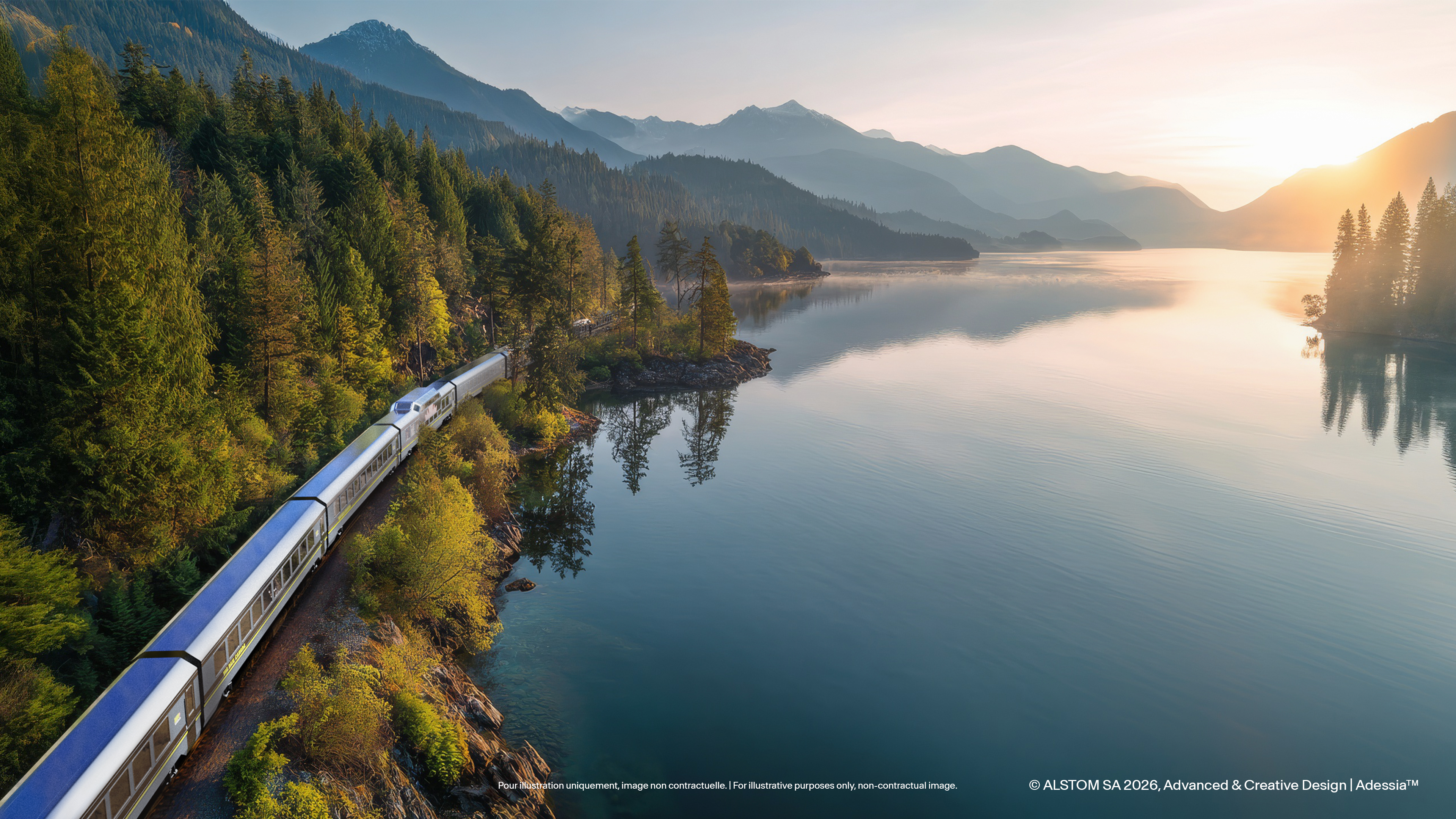
What I’m hoping for is that in 2075, some senior who rode an Alstom car in 2032 can sit down with a 20-year-old and talk about the same equipment. That’s a real possibility if VIA Rail and Alstom do this right. It requires a mid-life rebuild somewhere around 2060 without a budget yet, and ideally from the builder, whose obligations end in 2041.
The Budd cars were the future once, radically so, the stainless and the domes and the whole postwar promise of them. Nobody baked-in our affection for them while they were being designed. It accumulated, over 70 years of Canadians living with them, fixing them, complaining about the frozen toilets, and riding them anyway. Whether anybody loves an Adessia in 2075 depends a little on what Alstom delivers in 2031, and a great deal more on whether Canada lets them get old.