The Sublime Cannot Be Stored Like Treasure
On Peter Beagle’s The Last Unicorn, and what it teaches about beauty, possession, fidelity, and the cost of becoming real.
A note before beginning. What follows is a long reflection on Peter Beagle’s The Last Unicorn, and it discusses the novel from its first page to its last. If you have not yet read it and intend to, the book is gentler when met on its own terms, and you might wish to come back here afterward.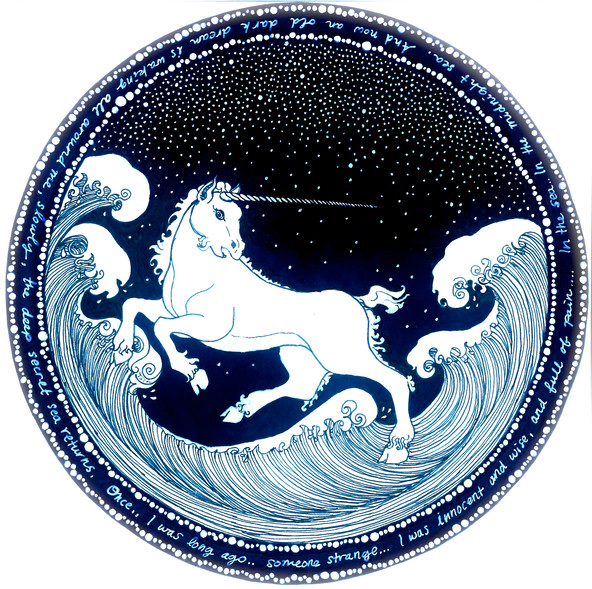
Peter Beagle’s The Last Unicorn came to me only recently. The book was introduced to me last year, and I finished reading it for the first time not long before I sat down to write about it, which is to say I am still inside the experience of having met it, and have not yet had the years of rereading and forgetting that usually intervene between a book and a careful essay about it. But, like many topics that enter my life, that doesn’t mean I swept through it like a storm only to be forgotten nearly as soon as the sun shone through. The book was read socially and slow rolled after first watching the movie months prior, which incidentally is my preferred way to enjoy stories, give me the taster and then let me read deeper into it. Otherwise, you get the Harry Potter movies, which shrivelled in their perfection as the books grew to immense tomes. Anyway, by the time I closed The Last Unicorn, I had the distinct impression that what looked, from the outside, like an unhurried fantasy quest about a unicorn searching for the rest of her vanished kind, was in fact an experiment of a very different sort. It is, beneath its costume, an examination of what it costs a being to enter time, and a quiet argument that the meaning available to creatures who can be lost may be richer than the meaning available to creatures who cannot.
The longer I think about Beagle’s novel, the more it seems to me that nearly every scene is doing two things at once, telling the story of a unicorn while gently arguing about ontology, about perception, about love, and about the price of becoming real.
There are a few movements in the novel I want to follow through this essay. The unicorn’s quiet shift from timeless creature into a being who has been told she might end. The question of who can still recognize her, and what the various seeings (and failures to see) say about the seer. King Haggard in his tower, the man who tries to possess wonder rather than receive it, and who functions as the moral centre of the book. Schmendrick the magician, whose problem is the inverse, the soul that tries to seize truth by mastery rather than allow it through fidelity. Molly Grue, who shows a third response to the marvellous that the novel treats with surprising tenderness. Amalthea, the unicorn made human, in whom mortality and love produce a kind of depth her former perfection had no room for. And the ending, where the world is repaired but the protagonist is not.
A creature who had not yet been told
The unicorn does not begin the novel as a protagonist in any familiar sense, and that may be the first surprising thing about her. She does not strive, does not grow, does not face the usual internal friction between who she is and who she might become; she has none of the strain of becoming, no inward gap between what she is and what she does, no anxious orientation toward a future in which she might be more than she presently is. There is a completeness to her that the other characters in the book conspicuously lack, and the forest itself seems to know it, organising itself around her presence less as one creature among many than as a kind of fact that the woods have been arranged to host.
A word about essence may be useful here, since I will lean on it throughout. By essence I just mean what a thing actually is at its core, before anyone has had a chance to name it, use it, frame it, or have feelings about it. A unicorn’s essence is what makes her a unicorn and not a horse, the part of her that exists whether anyone is watching or not. Essence does not get bigger when it is celebrated, and it does not get smaller when it is missed. The traveller who walks past her thinking she is a mare has not made her less of a unicorn; the witch who locks her in a cage and shows her off as a wonder has not made her more of one. What can change, though, is whether the creature lives in a condition that is only her essence, or whether something has crept in alongside it. History. Fear. The awareness of being lost. The novel’s interest in essence is mostly an interest in that creeping. The unicorn is still the unicorn at the end of the book. But she is no longer only the unicorn; she is also a unicorn who knows things she did not know before.
The opening of the book disturbs this so quietly that the disturbance can almost be missed. It helps first to truly take a moment to understand the implications of being a creature that is timeless, that is to say who is immortal and eternal, I suppose. She has no beginning or end, really, and has never cared about existence in any fourth dimensional sense, kind of like a child who knows no reason to care about time and instead relies on rhythm and an internal clock. Except, unlike children, she does not eat or drink, and unicorns in this universe are wary of sleep; all benefits of being eternal, yet all clear reasons that time has little effect on her consciousness, as there is no denotation of time really. So when two hunters pass through the forest, noticing the odd lack of seasons and the strange fertility all around them, and remark that unicorns may have vanished from the world, or perhaps only from everywhere but here, one of them, before they go, speaks aloud to her as a sort of half-believed kindness, telling her that wherever she belongs, she should go there, because the woods are not safe for her kind anymore. She has not been threatened, has not been pursued, has not been physically wounded in any sense, and yet from that moment forward something in her has changed. She has had to imagine, perhaps for the first time, that she belongs to a species that might end, and the act of imagining it has placed her into history in a way that no creature outside time has any business being. The opening pages of the novel are therefore not the beginning of an adventure so much as the dissolving of a condition, the moment at which an essence is first fractured by the simple accident of having heard something it had no inward defence against.
This is, in my reading, the philosophical signature of the entire book, and Beagle returns to it again and again under different masks. Every transformation that follows is, in some way, a repetition of this first one, an inquiry into what happens when something timeless is pressed by circumstance, and whether anything timeless that has been so pressed can ever fully recover the condition it began in.
The unicorn most cannot recognize
Once she sets out into the world, the unicorn discovers something that nothing in her previous existence has prepared her for, which is that most of the people who meet her do not see a unicorn at all. They see a white mare. They register, in passing, that her coat is unusually bright, that there is something graceful about her, and then they move on; she walks through villages and along roads and across fields, and almost no one looks twice. The disenchantment of the world is not announced in the novel, not lamented in any speech, not given to any character to explain. It is shown, gently and repeatedly, in the small fact that the most extraordinary creature in the story walks freely in the open and is mistaken for a horse.
What I find moving about this is how carefully Beagle avoids blaming the unicorn for being unseen, or the world for failing to see her, or any one character for the disenchantment that the book very obviously mourns. He simply lets the reader notice that some people in this world are still capable of recognizing her, and that the ones who can are not always good, while the ones who cannot are not always wicked. Mommy Fortuna sees her, but in the way a collector sees a prize; Molly Grue sees her at last and weeps that the unicorn did not come when she was still young enough to have deserved it; Schmendrick, a failed magician, sees her and is half undone by the recognition; King Haggard sees her, and feels, for a brief and unmistakable moment, that life might be worth enduring; Prince Lír, after his own fashion, sees her, and falls in love with what he only half understands. None of these recognitions resembles any of the others, and yet each of them is real, and the novel asks the reader to take seriously the possibility that there is no neutral way to see such a creature. Each of these recognitions is, in its own way, an act of reading. The novel implies, without quite saying so, that every character in this world is a reader of being, that to encounter anything at all is to interpret it, and that the moral status of a soul is partly determined by how it reads. The evil characters in The Last Unicorn are not chiefly cruel; they are bad readers. Fortuna reads marvel as commodity. Haggard reads transcendence as private medicine. Neither fails because they cannot see what is in front of them, but because they have made themselves into the kind of readers who can only translate the world back into themselves. The good characters, by contrast, are not chiefly kind; they are teachable readers, willing to be addressed by what they encounter rather than always addressing it themselves. To encounter her at all is already to have been disclosed by what one finds in her, and there is something in this book that sits adjacent to an older Platonism, the suspicion that the world is full of forms whose intelligibility depends on the moral and imaginative readiness of the perceiver, and that the failure to recognize a unicorn is not an innocent perceptual error but a small disclosure of how far one has drifted from the kind of soul that the world was once arranged to accommodate. In plain terms, the novel is suggesting that seeing rightly is not something one does to a thing, but something one becomes capable of.
It’s an awareness I’ve found really impactful, especially on a personal level. The unicorn is not changed when she is misread, and the misreading is, in itself, harmless to her; but it is not harmless to the one who misreads, because perception is the trace one’s interior leaves on the world, and to walk past a unicorn and see a horse is to have offered the world a confession one did not know one was making. I have caught myself in this more than once, walking on the alpine ridges of this island and watching the inlets in low evening light, recognizing landscapes the way one recognizes something arranged for display, drawing pleasure from the surface of them without quite asking whether I have remained capable of being addressed by what I am looking at. The unicorn does not need me to receive her well, and the country I love does not need me to receive it well; their being is not dependent on the quality of my attention. But my being, perhaps, is.
Receptivity is a word that can sound soft until you press on it. It does not mean passivity, and it does not mean being agreeable. It means letting a thing be as big as it actually is, instead of quietly shrinking it down to the size that fits comfortably inside the day you were already having. In practice, this looks like things people rarely do anymore. Watching the light fail on a mountain for ten minutes without taking the phone out. Letting a song end without immediately reaching for the next one. Reading a paragraph that startled you and sitting with it instead of pre-composing how you would describe it to a friend later. Walking through a place long enough that you stop quietly narrating your own visit to it, even silently to yourself. Receptivity is the inward decision to be moved by something on its terms rather than yours, not because being moved would be useful, not because being moved would make a good post, but because the thing has its own claim and the only honest response is to let the claim land.
To be addressed by something, in the sense the novel keeps quietly invoking, is to find that the thing is the one doing the speaking, and you are the one expected to answer. The mountain does not wait for your permission to put its question to you. The unicorn does not ask whether you have made room in your week for what she is. Whether their address lands, though, depends entirely on whether there is room left in you to hear it. A great deal of how the modern world is arranged, and how a modern self is trained, eats away at that room. Everything is curated for you in advance, framed before you arrive at it, captioned, ranked, scored, recommended, reduced to a thumbnail you can decide about in a quarter of a second. By the time you arrive at the thing itself, it has been pre-digested for your convenience, and the encounter, which was supposed to begin with the thing speaking to you, has been replaced by you having an opinion about it. Beagle’s novel has reminded me how much of my own perception has slowly been domesticated into management, and how much of what I once called love for a place was actually the love of having an opinion about it.
Closely related to both of these is wonder, a word the novel keeps reaching for and which deserves more than the children-and-fairy-tales reading it usually gets. Wonder, in the sense the book is using it, is not gosh-wow amazement, not the spectator’s flutter in front of something pretty. It is closer to an adult discipline. Practically, wonder is the capacity to look at something and not immediately know what it is for, what it costs, what it tells anyone about you for noticing it, what it would look like in a photograph, or what you would say about it later. Wonder is the brief refusal to file the encounter, the small inward agreement that the thing in front of you is not yet your thing, not yet something you understand or own or have a take on. It is the work of letting something stand in front of you while you, for a moment, are not the one in charge of what it means. And like any other discipline, it can be eroded. It can be eroded by busyness, by cynicism, by acquired sophistication, by the long and gentle wearing down that happens when one spends too many years in environments that reward being unsurprised. A great deal of the moral seriousness of The Last Unicorn, I now think, depends on its insistence that wonder is something that has to be tended in oneself, and that what looks like a story about a missing species is, underneath, a story about whether the world still contains the kind of person who could have noticed.
I would go one step further intellectually and suggest that to be receptive to the world, deeply open to it moving you, and feeling it in your core, is a form of virtue we never quite get to talk about as a virtue. You respect both yourself and the world by your vulnerability and your receptivity, and by the quality of attention that vulnerability makes possible. Polished admiration, the kind that never reaches anywhere it matters, is by comparison a small dishonesty; it pretends to a relationship it has never actually entered. The novel does not put it in those terms, and rarely would any of us be expected to speak in such rich velvety depth, but it is one of the things the book has done to me, to see that we all interpret the world from within, and that we must be open to all that it can offer if we want to see the truth of it.
King Haggard, and the wish to bottle the dawn
If the book has a centre of moral gravity, it is the figure of King Haggard, a character I seem to find myself relating to in unfortunate ways (mostly out of grief, disdain, and regret). He is the quieter, more disturbing sort of tyrant, a man who has lived long enough to acquire almost everything that worldly power can give him and who has discovered, in the having of it, that none of it suffices. He owns a castle and a kingdom, he commands a wizard, he has raised a prince, he sits in a tower above the sea, and none of this gives him joy; the only thing that gives him joy, by his own admission, is the sight of unicorns. The sense that watching them makes him young, that something in him is briefly restored when he beholds them moving in the surf below his tower. So he does what people in his condition often do, with a logic that is terrible precisely because it is so legible, and decides to keep them. He drives every unicorn in the world into the sea, where the Red Bull holds them in the breakers, and he sits in his window and watches the white shapes shifting under the moon, possessing the only beauty that has ever moved him, and ageing all the same like the curmudgeon he is.
The cruelty in this is undeniable, and the novel does not minimize it, but beneath the cruelty lies something heavier and harder to name, which is a kind of starvation. Haggard has lost the inner capacity to be visited by wonder, and rather than confront what such a loss says about him, he has tried to manufacture wonder by the only means his condition still understands, which is acquisition. He cannot receive transcendence, so he attempts to imprison it; he cannot be addressed by beauty, so he tries to own enough of it that he no longer has to wait for the address to come; he wants ecstasy without vulnerability, beauty without surrender, wonder without transformation, the kind of dawn that comes when called and stays for as long as the king is sad. Put plainly: Haggard’s hunger is not really for the unicorns themselves; it is for the inner condition that the sight of unicorns once briefly provided. He has confused the visitation with the visitor, and so has imprisoned the visitor in the hope that the visitation will follow it home. Spoiler alert: it does not, because it cannot.
The thing he wants is not the thing he is hoarding. What he is hoarding is the closest available stand-in for an inward state he has lost the capacity to produce in himself, and the longer the substitution runs, the further the original encounter recedes from him. The proxy is real enough; the unicorns are right there in his window every night. But the visitation the proxy was supposed to bring back never arrives, because visitations were never the kind of thing one could keep in the surf. The kind of beauty Haggard is reaching for is the kind that requires him to be a different man than the one he has become. There is no shortcut around that fact, and his entire life is the shortcut he has built anyway.
His offence is, in part, the kind that older moral traditions have always recognized. He is using the unicorns. He is treating them as a supply for his interior, a medicine he can dose himself with by looking out his tower window, and the whole premise of his project assumes they exist for the sake of what he can extract from them. The book is insistent that this is the wrong category for a creature like the unicorn. The unicorns are not for anything. Whatever their dignity amounts to, it lies in their being the sort of creature one meets rather than uses, and Haggard’s long life has been a slow training of himself to forget the difference. But his offence is also against himself, because the project of bottling the dawn is the project of a soul that has decided to settle the question of its own emptiness by acquisition rather than by repair. There is a sentence Beagle never quite writes but everywhere implies: the sublime cannot be stored like treasure, and any effort to store it injures the one who tries far more than it injures the sublime itself, because what was wanted in the first place was never the thing but the visitation, and visitation cannot be commanded into the cage where the king would like to keep it. Although, just to clarify, unicorns in the novel clearly can feel anxiety and fear, and the lands they occupy are kept eternally in the season of Spring, so without a doubt the entire world and 99% of its unicorns are actively being harmed and very much caged despite what I just said. But outside of the fantasy, when we humans attempt to cage something so pure, it really only harms the capturer, because we are fooling ourselves not only in the belief that our efforts are working externally, but that they are working internally.
There is a political dimension to all of this that Beagle does not labour but does not hide. Haggard’s kingdom is what a country looks like when sovereign power has been detached from the common good. The land is barren. The people are sparse. The castle is in poor repair. Nothing in the realm exists for any purpose larger than the upkeep of the king’s interior wasteland. A regime devoted to feeding the private deprivation of its ruler is, almost by definition, a regime that produces nothing of public worth. The kingdom reflects the man, and the man is a hollow that the kingdom has been bent to feed. The old intuition behind this, going back at least as far as Aristotle, is that real rule aims at a shared good, and that politics arranged for the inner upkeep of the ruler stops being politics in any meaningful sense; it becomes the public conscription of a private wound. There are versions of this same disorder that do not require a literal crown, and one of the uncomfortable things the novel does is make you see them.
A year ago I came very close to buying a piece of land on a mountain, with an accepted offer and a preapproval larger than the asking price, and I spent three months trying to close the deal long past the point at which any sensible person would have walked away, because I have a principle of following paths to their very ends even after the writing has clearly arrived on the wall. If that sounds foolish, you clearly need to rewatch The Empire Strikes Back to learn from the ancient green forest goblin. When the deal fell through I grieved for a surprisingly long time, having already imagined myself there in the wind on that ridge, having already loved the version of my future life that included that piece of ground, having kindled relationships with the neighbours, having planned and designed years of work I would do to the property, and for a long time afterward I told myself, with the kind of half-truth one tells oneself in such circumstances, that what I had lost was replaceable.
A year later I can see what I could not see in the middle of it. I loved the place, in some real sense, and I love the wild country of this coast, and I have no wish to talk myself out of that love. But there was something else in my reaching for it that I had not been quite honest with myself about, a quieter wish to convert the love into possession, a hope that owning the ground would settle a question I had not yet learned how to formulate, a desire to make the beauty of the place reliable, available, mine. I would not have used those words at the time, and I do not think I could have heard them if anyone else had used them on me, but I can hear them now. There has been in me, since I was young, a habit of looking at wild country that took its grandeur chiefly as scenery, drawing pleasure from the surface of it and not quite leaving room for the slower, more difficult work of receiving what was there; a way of treating beauty as a view to be visited rather than an address to be answered, and of taking from a place what one could carry away from it in pleasure without staying long enough to be asked anything in return. It was not Haggard’s wish to imprison the morning, not in any cruel or proprietary sense, because I have been loved well in my life and have loved well in return, and I have not built any towers against the dawn. But it was a smaller version of the same instinct, the kind that the surrounding culture trains into a person almost without their noticing, the kind that turns the question “what is this place” into the question “could this be mine,” and treats the second question as if it were a deepening of the first rather than a substitution.
What I have been trying to find since I lost the deal is the difference between possession and stewardship, which is not at all the same difference as ownership and non-ownership. The opposite of possession is not the absence of having; it is the presence of responsibility. Possession asks what a thing can do for one’s hunger, what comfort it can supply, what reliability it can confer. Stewardship asks what one’s responsibility becomes once one has been entrusted with something larger than oneself, what care the thing now requires from the one who stands in relation to it, what one might owe forward rather than collect inward. A steward can hold legal title to land and not be its possessor. A possessor can be a guest at the world’s table and still relate to everything on it as supply. The difference is interior, not legal. And one of the things the book has clarified for me is that I had not, until recently, understood my own want of land as a question about which kind of relation I was hoping to have. I had thought the issue was whether I could afford the place. The deeper issue was whether I was the kind of person who could afford to be entrusted with it.
I am, slowly, learning to notice the moment when loving a thing starts curdling into wanting to own it. The two instincts feel almost identical from the inside, and they share a great deal of their early grammar, but they tend toward very different lives in the long run. Loving a place, in the sense the book seems to mean by love, is a kind of long attention that does not require the place to be available on demand and does not need its beauty to be settled in one’s own name. Wanting to own a place, by contrast, is often a way of asking the place to answer a question one should not be asking it to answer, which is whether one is the kind of person who deserves it. Land does not answer that question. Mountains do not answer that question. Unicorns do not answer that question. Trying to make them answer turns the encounter into a transaction one has already lost before the negotiation has begun, and turns the lover into someone who can be embarrassed by a piece of ground. The unicorns escape Haggard in the end, as they were always going to, and it is one of the small mercies of the book that he is not so much destroyed as left to the consequences of what he had spent his long life becoming.
Schmendrick, and the magic that refused to be summoned
If Haggard shows what happens when the soul tries to secure wonder by possession, Schmendrick shows the opposite problem, what happens when the soul tries to secure truth by mastery. The two errors are mirror images, and the novel takes the second nearly as seriously as it takes the first, even though it does not produce any of the obvious cruelties.
Schmendrick is, of all the human figures in the novel, something of the noble fool, with a kind and misguided heart. He is a magician who cannot reliably summon his own magic, and who lives, much of the time, inside the gap between intention and result. He attempts large effects and produces small ones; he reaches for power and grasps only its edges; he is competent in the technical aspects of his craft and entirely unreliable in the ways that matter, and the great question of his life, the one he carries from the first page nearly to the last, is how to acquire the kind of mastery that would close the gap, the kind of skill that would let him will an outcome and have the world cooperate.
I recognize the disposition from inside it. My instinct, in almost everything I attempt, is to ask how to become capable, how to ride the bicycle without the training wheels, how to manage the risk without external supports, how to write without computer aided grammar, how to rule out error in advance by knowing enough about the territory that error itself becomes unlikely. The shape of my attention is mastery; the questions I tend to ask of any new thing are technical questions, oriented toward acquired competence, toward the slow closing of the distance between what I intend and what occurs. There is real value in this disposition, and I will not pretend otherwise, because much of what one must do in the world is in fact answerable to study, to practice, and to the patient accumulation of skill. If not for these things, the quality of life for most humans would not be so much greater than decades or certainly a century prior, so long as we do not measure quality with our hearts, that is.
But there is, alongside it, a different disposition entirely, and I have come to see, over the months that I have spent thinking through this book, that I had spent much of my life unable to take it seriously as a real alternative. Its central questions are not technical but moral, and they cannot be answered by study, or by the closing of any gap. They are questions of a different shape altogether: what must I remain faithful to, even when keeping faith is costly; what value must I refuse to betray, even under pressure; who matters most to me, and what would it mean to live as if that were really the case; what must I refuse to do, even when not doing it brings difficulty into my life. Rather than questions of capability, these ask about character, about maturation, about the slow growing of a soul into the kind of shape that the right things can inhabit; they do not ask how to do, but how to remain; they do not seek mastery, but fidelity.
The novel is quietly clear that these are not the same disposition, and that they reach the truth by different paths. Mastery reaches it through analysis, cunning, and force of will, producing in the end a kind of competence; fidelity reaches it through loyalty to what is actually the case rather than to what one would prefer the case to be, and produces, in time, a person who can be trusted in proximity to something fragile. Both can be honourable, and at their best they support one another, but there comes a point in any life when one is asked to love something or someone, and at that point the difference between the two grows nearly unbearable. Love by mastery is, when it is well done, the kind of performance one can admire from across a room: a careful study of another person, an offering of what the analysis predicts they want, a series of accurate readings of mood and need. Love by fidelity is less spectacular and far harder to take in at a glance, but it is the kind of love that endures the actual conditions of a shared life, that survives the moments in which masterful performance fails, that does not require the lover to be uninterrupted in their skill in order to be uninterrupted in their care. The two do not have to exclude each other, and at their best they sustain each other, but if one had to choose between them, the book is in no doubt about the answer.
Schmendrick receives his magic at last, not by mastering his craft, rather he does not master anything in the end; what happens to him instead is that he becomes, finally, the kind of person whom magic is willing to inhabit, and the order of those things is the whole of the lesson. Capacity follows character and the instrument can only carry what the instrument has grown large enough to carry. There is no shortcut from where Schmendrick begins to where he ends, and no amount of additional study would have taken him there; the only path between the two is the slow alteration of who he is, and the magic, when it finally comes, comes through him rather than from him. Ursula K. Le Guin’s wizards in Earthsea operate on a kindred principle, that a magician’s power is bounded by the magician’s character, that knowing a thing’s true name is one accomplishment and being permitted to use that name well is another, and that the second always trails behind the first; Schmendrick arrives, by the end of The Last Unicorn, at something like the disposition Le Guin’s school spends years trying to teach.
I do not yet know how to live as a man whose primary question is fidelity rather than mastery; I have spent a long time becoming someone who can rule out error, and the corresponding skill of remaining faithful to what cannot be ruled out is not in the same shape and does not grow in the same way. But I have at least come to see that it is a different skill, and that the inability to recognize it as such was one of the more expensive errors of my younger life.
Molly Grue, and the wonder that arrived late
There is a third response to wonder in The Last Unicorn, and it belongs to Molly Grue. If Haggard sees the marvellous and tries to imprison it, and Schmendrick sees the marvellous and tries to serve it competently, Molly sees the marvellous and grieves the years in which she was not ready to meet it. Of all the characters in the book, she is the one whose reaction I find most unsettling, and the one whose example feels most useful to keep nearby.
Molly is a tired woman travelling with a band of incompetent outlaws when the unicorn first walks into their camp. She is not noble, not magical, not young, not anything literary tradition usually selects for a moment of high beauty. And her first response to the unicorn is the most striking line in the book. She does not gasp. She does not bow. She does not feel made young again, the way Haggard would have. She accuses. “Where have you been?” she cries. “Damn you, where have you been?”
It is a confused reaction on its surface. Why would anyone be angry at a unicorn for finally arriving? But the more one sits with that line the deeper it goes. Molly is not angry that the unicorn exists. She is angry that the unicorn did not come when she was young enough to have deserved it, when wonder might still have arrived in her life as innocence rather than as belatedness. She has waited a very long time for something her culture insisted no longer existed, and now that it has at last shown up, she must receive it as the weathered middle-aged woman she has become, and not as the girl who could once have met it with an unbruised heart. The encounter is not less real for arriving late. It is not less worth receiving. But it costs something different from what it would have cost in earlier years, and the difference is the substance of her cry.
I think Molly is the most quietly heroic figure in the novel, partly because her arc requires the least transformation and the most honesty. She does not need to be remade by the unicorn’s arrival the way Schmendrick is, and she does not need to be undone by it the way Haggard is. She only needs to admit, in front of the very thing she has been waiting for, what the waiting has cost her. The novel rewards her by making her, by quiet implication, the one human character who never misreads the unicorn from beginning to end. She has earned her seeing the only way the book seems to think it can really be earned, by having waited a long time without giving up the capacity to recognize what she was waiting for. There is, in that, a lesson about wonder that neither Haggard’s possession nor Schmendrick’s mastery quite reaches. Some encounters with beauty arrive when the meeting can no longer be innocent. The book’s assertion, simply put, is that this does not make them less worth meeting.
Amalthea, and the body she learned to grieve
The most metaphysically extraordinary moment in the book is also the most emotionally direct, and Beagle’s mastery is that he refuses to choose between those two registers. To save the unicorn from the Red Bull, Schmendrick transforms her into a human woman, and she does not merely take on the appearance of a body; she takes on a body’s temporality. She acquires time, and fear along with it, and that strange narrowing of attention which mortality teaches without permission; she begins to feel, in the smallest and most embodied ways, that the day will end, that the year will end, that she herself can end, that there are losses ahead of her which she cannot yet imagine but will not be able to refuse when they come. She acquires the possibility of love, and with it the possibility of losing love, and from these she begins, slowly and against her will, to forget what she had been before.
Prince Lír deserves his own moment here, because his arc carries the same argument from the opposite direction. When he first appears, he is a young man raised on heroic stories who is, with some embarrassment, trying to enact them. He composes bad poetry. He hunts harmless animals because storybook princes hunt. He performs nobility before he has quite become noble. There is a philosophical mistake in this that Beagle takes seriously without ridiculing, because Lír is treating heroism as a script that can be worn from outside, hoping that the costume of virtue will produce the inward fact of it. But it is also one of the truer mistakes a young person can make; we grow into our titles and our words before we have fully earned them, and the entering is not pretence exactly, but a kind of advance commitment to a meaning one hopes to one day carry. The difference between rehearsing nobility and being noble can only be closed by the kind of love that makes virtue costly, and that is what Amalthea finally gives Lír the chance to find. He becomes truly noble only when his love for her grows real enough that staying in it would mean losing her to her own nature, and leaving it would mean keeping her alive. He begins by trying to act like the kind of man stories admire; by the end, he has become the kind of man who can lose what he loves without ceasing to love it.
Lír falls in love with her, in the way young men in such stories fall in love, and against everything in her former nature she begins, in time, to love him back. When the moment comes for her to remember herself, to take her old shape, to walk down into the surf and meet the Red Bull as the unicorn she has always been, she does not want to. She would rather stay. She would rather be Amalthea, mortal and vulnerable, accompanied by a particular man at a particular hour of a particular life, than return to the cold completeness of the creature she once was. A more reductive book would have framed this as a moral failure, a temptation to be overcome by some show of resolve, but impressively, Beagle does no such thing; he treats her resistance as the inward arrival of meaning, the moment in which she has begun to live her life from within rather than merely to be it from above, and her sorrow at the prospect of returning is not a falling away from her former perfection but the first tangible evidence that something in her has become inwardly real.
There is something the existentialists have always reached for in moments like this one, even though Beagle himself never uses the word. The basic intuition is that real meaning tends to show up under pressure, that it requires limits, irreversible choices, and conditions one did not sign up for. The unicorn, before her transformation, has freedom only in the thinnest possible sense. She is what she is, and there is no inward distance between her and herself, no place inside her from which she could choose against her own nature, because there is no one else inside her to be doing the choosing. As Amalthea, she acquires the heavier kind of freedom, the kind that arrives with the real possibility of betraying who she has always been. She could remain mortal. She could choose Lír over her own kind. She could let the other unicorns stay in the sea. The fact that the choice is actually available to her is the whole of her new condition, and the deepest mark her transformation leaves is not that she ended up choosing rightly or wrongly, but that she became, for a span of time, a being who could choose at all.
It is tempting to read all of this against the kind of bookish wisdom that says one should not get too attached to things one cannot keep. A version of that idea has been around for a very long time, from the ancient Stoics onward, and it has a kernel of truth in it. Some kinds of clinging really are ruinous, and the book does not pretend that Haggard’s possessive grasp or Fortuna’s hungry custody of the marvellous are anything less than that. But it refuses the conclusion that has often been drawn from such reasoning, which is that one should therefore keep the precious things at a safe inward distance, loving them lightly, ready to let them go at a moment’s notice. Amalthea’s grief is not treated as a mistake she should have known better than to make. The novel does not ask her to rise above it. It suggests, instead, that to be marked by what one loves is exactly the right way to love it, and that the alternative, a perfection so insulated from loss that nothing can really happen to it, is not a higher form of being but a thinner one.
She is convinced, in the end, to return, and the unicorns are freed, and the Red Bull is broken, and the kingdom falls, and the world is repaired. But she does not return to what she was. She tells Schmendrick that she has been mortal, and that no other unicorn has ever been mortal, and that this fact will follow her into immortality and never leave. She has known love that ends. She has known regret, which could be seen as evidence that a being has touched something it actually valued. She has been wounded by time in a way that the rest of her kind have been spared, and the wound cannot now be undone, because the immortal version of her will go on remembering it forever.
This is the book’s deepest statement is that a perfection that has never been vulnerable is splendid in its way, but somehow thinner than modes of being that have grown around an injury; and a vulnerability that has never been touched by transcendence is richer than perfection but finally tragic, lit only from below. The unicorn at the end of the novel is the only being in the story who has carried both at once, who has been an essence that became experience and experience that returned to essence, and the book suggests, quite gently, that this combined state is the highest form of being available within its world. She is the first of a new kind of creature, and she will be alone in it forever, and the novel does not pretend that this is uncomplicatedly good; but it does not pretend, either, that she should have remained untouched.
What the unicorn carried back
It would have been easy for the novel to end with a return to before, with the unicorns freed and the spell broken and the unicorn herself slipping back into the forest as if none of it had happened. That is the shape of restoration, and almost every fantasy quest takes that shape, because the promises of the genre seem to demand it. The Last Unicorn refuses it. The world is repaired, but the protagonist is not restored, and the book takes some care to make sure the reader feels the difference. The unicorn cannot go back to being the creature who had not yet heard the rumour in the forest, because that creature was constituted by not yet knowing, and now she knows; she knows that the others can be lost, that she can be transformed, that she can be loved by a particular person at a particular hour of a particular life, and none of those things can be unknown once they have been lived. The world will be repaired around her, but the work the book has done cannot be undone now without undoing the book. Much like our dear Frodo Baggins of the Shire, she is now marked by experiences which, though far less scarring, are still more than adequate to fundamentally alter her character forever.
There are two flavours of nihilism the novel could have settled for at this point, and it refuses both. The first is Haggard’s, the cold conviction that ordinary life does not contain enough meaning to be endured without stealing from the marvellous. The unicorn’s return to the forest at the end is a quiet refutation of that view, because the forest is ordinary, and she does not return to it diminished. The second is the more refined kind of nihilism that holds that because beauty passes, beauty is finally meaningless, that transience hollows out value rather than constituting it. Amalthea’s love for Lír refutes this. She knows the love will end. She loves him anyway. She knows she will outlive him by centuries. She loves him anyway. The book’s soft claim, is that the passing of things does not undo the meaning they had while they were here, and that demanding permanence as a precondition for meaning is the very thing that produces the false choices nihilism then trades on.
It is worth saying briefly that the ending also refuses any kind of utilitarian summary, the sort of moral arithmetic that adds up the freed unicorns and the fallen kingdom and the restored world and declares the books balanced. One could compute, on a sufficiently impersonal ledger, that net flourishing in the universe has improved. That is not why the ending feels the way it does. What gives the ending its weight is not the total but the particular: Molly’s cry in the camp, Schmendrick’s slow becoming, Lír’s costly love, Amalthea’s regret that will not soften with time. None of these is a unit in a calculation. They are the substance of why the ending matters, and they cannot be added together.
What I find consoling about this, rather than tragic, is what it suggests about losses in general. Some losses really are only depletions, but others, when one looks back at them with a little distance, turn out to have been the conditions under which some kind of depth became possible at all, and they begin to look less like wounds in retrospect than like the price of admission into a way of being that one could not have entered while still uninjured. The piece of land I did not get. The mistakes I have made out of a desire to master rather than to remain faithful. The years in which I treated wild country as scenery, and not as something that might address me if I left enough room for it to do so. None of these is reclaimable as a missed possession. But they are not nothing either; they have been the slow work by which I have learned to ask better questions about why I want what I want, and what kind of seeing I am still capable of when no acquisition is on offer.
The unicorn at the end of the book does not regret having been mortal. What she regrets is that she will live forever, and that the memory of mortality will not soften with the centuries the way ordinary memory softens with time, and that there is no other unicorn in the world with whom she can share what she has now carried back from her brief stay inside a human life. That is the price of her transformation, and Beagle does not make it out to be small; but he does not pretend, either, that she should have remained the creature in the forest who had never been told. The book’s quiet wisdom is that one cannot return to innocence unchanged, and that this is, in the end, the right shape for a life: to be capable of being visited rather than to insist on being supplied, to love faithfully rather than masterfully, to receive the beautiful thing in front of one without first asking whether it can be made one’s own. These are not lessons I expected to take from a book that arrived wearing the costume of a fantasy. But the book, beneath the costume, is one of the gentlest and most demanding things I have read in a long while, and I suspect I will be returning to it for years.