The Why
The first episode of Elsewhere, Slowly, for anyone who’d rather read: why the show exists, and how a stubborn, technical kid who was rarely told why grew into someone who can kneel beside a patch of moss and feel something close to reverence.
This post is the script of the first episode of Elsewhere, Slowly, adapted a little for the page. If you’d rather listen, the episode is right here, and it runs about twenty-two minutes.
Before I ask for any of your time, I think I owe you something I was almost never given growing up, which is a reason.
When I was a kid, I asked why a lot. Why are we learning this, why does it matter, why should I care about the angles of a triangle or the order of the planets. Most of the time the answer was some version of “because,” or “because you’ll need it for your career someday,” and sometimes the answer was to be told to stop asking. I don’t think anyone meant harm by repressing me, but a child who’s handed a task without a reason tends to learn one of two things. Either they learn to stop wondering, or they learn to go out and find the reasons for themselves. I went looking, and in a lot of ways I’ve never stopped.
So this first episode is my answer to why the podcast exists. The short answer is that some people would rather listen than read, whether their hands are busy or their eyes simply can’t take a minute more of screen time today. The long answer is a story, about how a very logical, very technical, fairly stubborn boy slowly became a man who can kneel beside a patch of moss and feel something close to reverence, and who wants to tell you about it. That’s the story I’d like to tell you today.
The Missing Why
I grew up in Ontario, in the French school system, which meant every class I took, from math to gym, was taught entirely in French. It also meant that, at least at school, I was raised in the Roman Catholic faith. We sang the national anthem in the mornings, which I still think is a good and ordinary thing that some schools in this country have let slip away, and we prayed. Around Easter and other ceremonial days we’d take communion, a thin, dry, round wafer that tasted a bit like paper, and a tiny sip of mustum, a grape juice whose fermentation had been stopped so early it barely carried any alcohol at all. For a while that sip came from a shared chalice, and later on from little paper cups.
I rarely set foot in an actual church, maybe the odd Easter egg hunt or when I was baptized in a cute little suit and tie. Nearly all of my religious life happened inside my school, woven between lessons and recess, and none of it ever came with a reason that reached me. I went through communion more times than I care to recall and felt nothing, apart from the particular boredom of something that took time away from class, which somehow managed to be the only thing worse than class itself. I’d like you to hold on to that bread and that juice for a while, because we’re going to come back to them.
School was loud. If you couldn’t answer a question, if your attention drifted, if you acted up, you got yelled at, and that was true from elementary right through high school. If your work came back poorly, you got disappointment, and sometimes something colder than disappointment, a kind of disregard, as though you’d been quietly filed away. To be fair to my school board, they really did try. There were sports and safety programs, barbecues and pyjama days, and cultural days that made us proud to be learning in a second language. We even had a short unit on the War in the Woods, the logging protests out here on the west coast, which at the time was still the largest act of civil disobedience in Canadian history, and it was taught with surprising passion. But the one thing I needed most, a reason behind any of it, never came in any meaningful way.
So I found my own. It started the way it does for a lot of kids, especially these days, with entertainment on a screen, and it grew into a hunger to understand how the world actually worked. I watched history shows constantly, and by the end of elementary school I knew far more about the twentieth century, the World Wars and Vietnam, than my school had ever tried to teach me. I loved How It’s Made, watching machines take raw material and turn it into something ordinary, over and over, perfectly, and never getting tired of it. And then there was MythBusters, which I think helped wire how I looked at the world. Here were two grown men who, whenever someone said a thing was true, answered by going out to find out for themselves. I didn’t realize it then, but that habit of testing things was already wearing away at the faith that was being painted onto the surface of my mind, a faith that never really soaked in.
I wasn’t alone in that curiosity, either. Looking back, I think I was friends with the youngest engineer, the youngest audio-visual engineer, and the youngest astronomer I’ve ever known. My friend Philip loved mechanics, sprockets and chains, springs and pulleys, axles and their bearings, every piece of hardware that moved, and his passion gave me a reason to be fascinated by all of it. We spent hours assembling Lego, including a little maze for his pet lizard, a skink if I’m remembering right. John was fascinated by sound and sight, capturing and bending and transforming video and music and recordings. One of the earliest clips of yours truly is John and me with garden snails on our faces, thanks to his love of cameras and my curiosity about living things. At least my mom thought it was cute.
And then there was Brett. Brett had a much older brother who was brilliant and had rebelled against the values of our school board long before Brett or I got around to it, so Brett showed up with a mind that was already bigger than the classroom, full of the universe and everything drifting around in it. Together we started a YouTube channel called Canerdian Gaming. It never grew past a couple hundred subscribers and a little shy of two hundred videos, but for years we played games, learned about computers, and talked about science news nearly every single day. If you look at the tiny icon at the top of your browser tab when you visit my website, or the podcast’s website, that’s the Canerdian Gaming favicon. I never replaced it. I suppose that makes Elsewhere, Slowly my second show, though it’s taken me a long time to find my way back to a microphone.
Outside of school, I became a kid who thought a lot and knew a lot for his age, but for all that thinking did pretty poorly on paper. My mother’s street smarts and cunning rubbed off on me, and almost every night I was on Skype with friends scattered all over the world. I had this stubborn, almost physical need to learn, strong enough that I’d make myself read Wikipedia for hours even while it was putting me to sleep. My teachers would call my mother in, and the message was always the same. They weren’t worried that I was stupid or clueless. They were frustrated, because they could see what I was capable of. I held my own talking with adults, I picked things up quickly, my presentations were excellent, and yet I handed in almost no homework and barely scraped by on some tests.
Frankly, I thought the homework was pretty dumb, and I had other things I wanted to learn. Most of the tests were rote memorization, but whenever a test asked for even an ounce of logic, I did pretty well. The strange exception, shocking as it may be to those who know my career, was math and science, and that came down to language more than anything. I was learning math and science in French during the day and teaching myself different math and science in English at night, so every science test was also a translation test, and what I actually knew never quite lined up with what I was being asked. I was a remarkably strange student, one who was already planting the seeds of what would become the forest of my career, and I could already sense which resources that forest would need most, and very few of them were on the curriculum.
Uprooted
One summer, my mother and I moved across the country. We left our blood relatives, we left my friends, and I left my French education behind. From grade eleven on I was in French immersion, which in British Columbia actually meant something, since there were so few full French schools that immersion had to carry the weight. But it also meant that chemistry, physics, and math were suddenly in English. After years of learning those subjects in French during the day and teaching myself in English at night, the switch hit me pretty hard. Thanks to all that self-teaching, only chemistry, physics, and pre-calculus came back as C’s, and the rest was average or better. Once again, perhaps a bit shocking to anyone who knows that I’m advanced in my IT career.
The harder part of that move wasn’t the grades, though, it was the people. By now I was already familiar with this experience and was worried, quite rightfully as it turns out, that this would become a pattern. When I finished elementary school, most of my friends went on to a different high school, and I lost my teachers, my streets, and a lot of my friends in one summer. Two years later I lost them again, this time by moving to the other side of the country. Two years after that, having made a single lasting friend, I went off to college, once again losing my daily routine and everyone in it. Two years of post-secondary later, the same thing happened, and I came out of it with two friends I still talk to about once a year.
When you’re uprooted every two years, you stop expecting people to stay. You still care about them, sometimes more fiercely than you should for such short-lived relationships, but part of you is always aware of them being interim or ephemeral. You learn to be self-sufficient because you have to be, with few friends and just as few family members, and you learn that you are the only thing that comes with you every time. I grew up with very few concrete ties to any community, and what I held on to instead were values: science, respect for others, and generosity. Those came with me everywhere, and so too, it turned out, did the land.
Moving to British Columbia took twelve days, and those twelve days showed me more of my own country than I’d seen in my entire life. I’d been to Florida and back, and I’d driven up to see my relatives in Sault Ste. Marie every year or two, but I’d never seen anything like this. The boreal forest I recognized as the periphery to my world gave way to endless fields of gold and rolling hills of dark green grass that moved in the wind like the surface of an ocean. Eventually, those oceans of grasses gave way to mountains so immense I didn’t have any frame of reference for them. I remember feeling small and being told that my great-grandmother once came out to see the mountains, but she found them intimidating; I found them to be incredible. Last of the wonders I would see that summer was the coast. The water here was bluer and wilder than anything around the peninsula of southern Ontario where I grew up, the beaches were stunning, and the forests felt ancient in a way I’d never encountered.
In that first year, I travelled the whole southern coast of Vancouver Island, from Victoria out to Port Renfrew, over to Lake Cowichan, and back to Victoria again, what’s formally called the Pacific Marine Circle Route. Between a new high school and a rocky home life, there wasn’t much I could do out there besides stare in awe, or lie in the summer sun with the cool breeze coming off the ocean. But over time, those same pressures made me want to see more of where I lived. My eyes couldn’t get full. I couldn’t deny how beautiful this coast was compared to the flat, repetitive, polluted urban sprawl I’d come from, and even as a teenager I understood that I’d landed somewhere I should be immensely grateful for.
What I felt then, though, was mostly awe and hunger, the feeling of a kid pressing his face against a window. What I feel today is something much deeper, an intense love and gratitude for the depth, richness, and complexity of Canada’s alpine and maritime wilderness. The rest of this story is really about how I got from one feeling to the other.
Mettle
As I got older, work started to consume me. I didn’t find a community outside of my extended family, or when I did, I couldn’t seem to hold on to it, so I poured myself into working and learning and trying to become a better person. Every job taught me something, and while I felt mature for my age, working jobs that people my age rarely held and travelling often, I was still very capable of making mistakes, and I made plenty.
As a teenager, I pushed through my struggles mostly by working and studying myself to exhaustion. Some days I’d be at my high school from eight in the morning until one the next morning, because I was on the theatre AV production crew and we didn’t leave until the cleanup was done. Later I’d take a two-hour bus ride to college for an eight o’clock class, and another two hours home after seven at night. When I couldn’t hold it together anymore, a school counsellor would witness my semesterly breakdown in their office, and I’d do my best to reset for the next semester. It wasn’t sustainable, and I knew it wasn’t, but it gave me a kind of mettle that made me who I am. I learned that I could do a great deal and withstand a great deal more.
What really shaped me, though, was learning what stress and anxiety actually mean. I heard a lot about the struggles of people my age, and I don’t doubt most of them were real. But it’s an emotionally charged thing to be a teenager sitting behind a thirty-two-channel soundboard running a theatre production with a full live band. More so to be an adult responsible for the five hundred staff who will either be paid to sit around or be sent home tomorrow if you can’t get an entire central computer system back online by eight in the morning. At that point, my world had grown bigger than the one my peers were living in, and I didn’t always have room left to feel the smaller things alongside them.
The emotions weren’t somehow deeper or stronger because of a reason as narrow as being fired. It was the children, the customers, the patients, the people without homes, whoever that employer served every day and who wouldn’t be if I failed at my job. I was afraid for and of my coworkers, who’d be frustrated, or disappointed, or out money because of something I couldn’t fix. My emotions were tied to a much larger circle of people, and to harder problems, and so they climbed to heights I could easily regret having felt. It’s not for a lack of empathy that I couldn’t always relate to my peers, but my empathy rested with a more serious set of emotions and circumstances than most people my age were experiencing.
Loss, and the Tombstones
Experiences can’t be undone, not easily, and I’ve come to believe that every one of them carries some value, even the ones that are losses. All humans eventually feel loss, and even from a young age I had my share of it. My mother and I lost her father. I lost the man who’d been my father figure. And then I lost my biological father. Each of those losses reached into me differently, and each one took something I didn’t know how to replace, and in every case it took away the paternal guidance I needed throughout my life.
But those weren’t my only experiences. Through all of the complicated and difficult years that make up my life, I kept travelling, and the world around me has filled my cup every time it’s run dry.
It really started a few months after I lost my father figure, when my extended family, the family I found rather than the one I was born into, took me on a canoe trip into Tombstone Territorial Park in the Yukon. I helped drive much of the way from Vancouver up to Dawson City in a remarkably short five days, and in those five days I saw biomes and ecosystems, geology and towns, that I hadn’t just never seen, I hadn’t even known they existed. Like volcanoes, and open tundra. I was grieving, and I didn’t have much language for it, but the land didn’t ask me for any. It just kept unfolding in front of me, mile after mile, until somewhere along the way I noticed I was breathing more easily. I learned a great deal on that trip, and I healed a lot from the distance, the adventure, and the essence of those lands.
The Tombstones have called to me ever since, more than any other part of Canada except maybe Vancouver Island. That calling keeps bringing me back, in winter, in summer, and now this autumn of 2026. Since that first trip, I’ve crossed into all ten provinces thanks to my best friend, and I’ve taken the train across Canada twice to return to the French culture I grew up in. Every time I travel, I seem to bloom, and with each of those seasons of growth I find something new I’m capable of. Time may always be finite, but I’ve yet to find a ceiling above my heart.
From Consuming to Communing
When I first started travelling, the desire was fairly shallow, though I was oblivious to that in my early twenties. I wanted to see more, and seeing more felt good. It was dopamine, pulled from whatever happened to reflect in my eyes, and I kept chasing the next view the way you chase the next episode of a show.
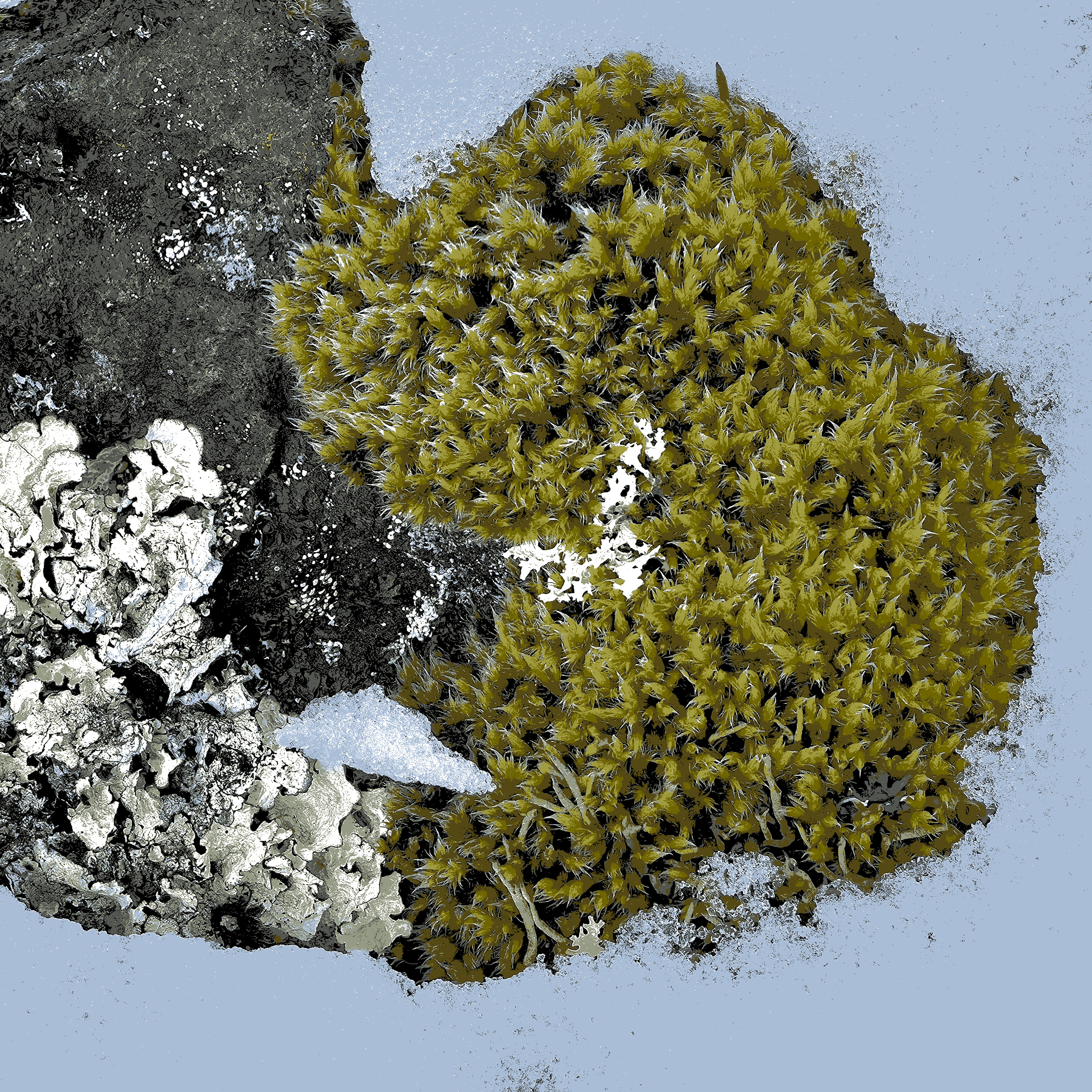
Slowly, and I mean slowly, over years, that changed. I started to admire the mosses, the way they carpet a fallen tree and turn endings into beginnings. I grew fond of the squirrels scolding me from the branches. I found inspiration in rocks, all their shapes and sizes and colours, each one holding a history longer than anything I could imagine. I learned to respect a place, not only by keeping my litter out of it, but by giving it my time, marvelling at it while I’m there, reflecting within it, and carrying it with me long after I’ve left.
Some people would call that communing, and without any irony, I think that’s the right word. Remember the paper-dry wafer and the sip of juice from my childhood, the ritual I went through again and again without ever feeling a thing? It turns out I was capable of communion all along. I just needed it to come with a reason. I still do it in my rational, reasoning way, mind you. I read about the ecology of a place, what lives there and why it matters, and then I sit with it long enough to understand, philosophically, what it’s worth. The facts don’t get in the way of the wonder. The facts are where the wonder comes from.
That ability, taking facts and finding wonder in them, is something I think we’re slowly losing. We seem to be losing our capacity to be surprised, or shocked, and alongside that we’ve lost a lot of our common ground, a shared set of experiences and understandings. We see statistics every day and rarely stop to ask what they mean, and reflecting on them at all has started to feel like a waste of time. Critical, reflective thought is treated as uninteresting, and because we practise it less, living deeply and meaningfully has become uncomfortable for a lot of people. I don’t say that to scold anyone, of course. It’s just, I know now how much I would have missed if I’d never learned to slow down.
So, Why a Podcast
So that’s my why. I’ve been lucky enough to lead a life I know is extraordinary, but for a long time I couldn’t truly appreciate it. I could see it, and I could list the places I’d been, but I couldn’t feel it the way it deserved to be felt. Learning to do that has taken most of my life so far, and it’s the most valuable thing I’ve ever learned.
I write this blog for the same reasons I sit behind a microphone for the podcast. I have things I’ve witnessed and felt that I want to share, sharing them makes me feel good, and I believe they can bring something unique and valuable into your life, even if it’s just a few minutes of seeing a place through someone else’s eyes. The episodes will draw from this writing and from my photo archive, and they’ll wander through travel, people, places, and ideas, which is to say, all the things that taught me how to appreciate being alive.
That’s also why the show is called Elsewhere, Slowly. Elsewhere, because most of what I’ll talk about happened somewhere other than where you’re sitting right now. And slowly, because slowness is the whole point. It’s what turned a hungry kid with his face pressed against the window into someone who can sit on a rock in the Tombstones or Kluane and feel at home.
This episode is, of course, going to stand out a lot from the rest, but I’d like to make this final piece a ceremonial element. Each episode, including this one, will end with a poem, and here’s the first one:
the way a sheet slides from furniture in a house
nobody's opened since October,
and underneath, the mosses were already green,
green in a way that had waited eight months
under tremendous weight somehow surviving.
Sphagnum drank the melt until it couldn't hold another drop,
then held it anyway, red at the crowns, gold in the hollows,
the whole valley floor a sponge wrung out.
On the rocks the lichens were brittle as old paper
until the afternoon rain came through,
and then they softened, flushed, went olive and grey-green,
as if someone had turned bleached paper to colour.
They'd been alive the whole time,
only willing to show it
when warmed and nourished.
Thank you for reading. If you’d like to hear what comes next, you can follow Elsewhere, Slowly on Spotify, Apple Podcasts, YouTube, Amazon Music, or any podcast app that takes an RSS feed, and I’ll see you somewhere else, soon!